The Response Curve: How Mortgage Direct Mail Marketing Decays Differently Than Digital Lead Gen
At Loansure, we don't have a favorite channel. We have a favorite outcome — funded loans — and a system that deploys whatever mix of channels gets there most efficiently. But being channel-agnostic doesn't mean treating channels as interchangeable. Every channel has its own physics: how fast it responds, how it prices, and — the one almost nobody plans around — how it *decays*.
That's what this deep dive is about: the response curve over time, and why its shape should change how you staff, how you measure, and how you build your acquisition mix.
Two very different shapes of demand
Launch a digital campaign — an email blast, a paid social push — and the response arrives like a firework. Engagement peaks within one to four hours of launch, and within a few days the campaign is effectively over. The message is buried, deleted, or scrolled past, and the curve falls to zero.
Mortgage direct mail behaves like a completely different substance. Responses build slowly as pieces land, peak around days three to seven, and then keep arriving for weeks. Industry benchmark studies put the average household retention of a mail piece at around 17 days — and response tails routinely stretch past week six.
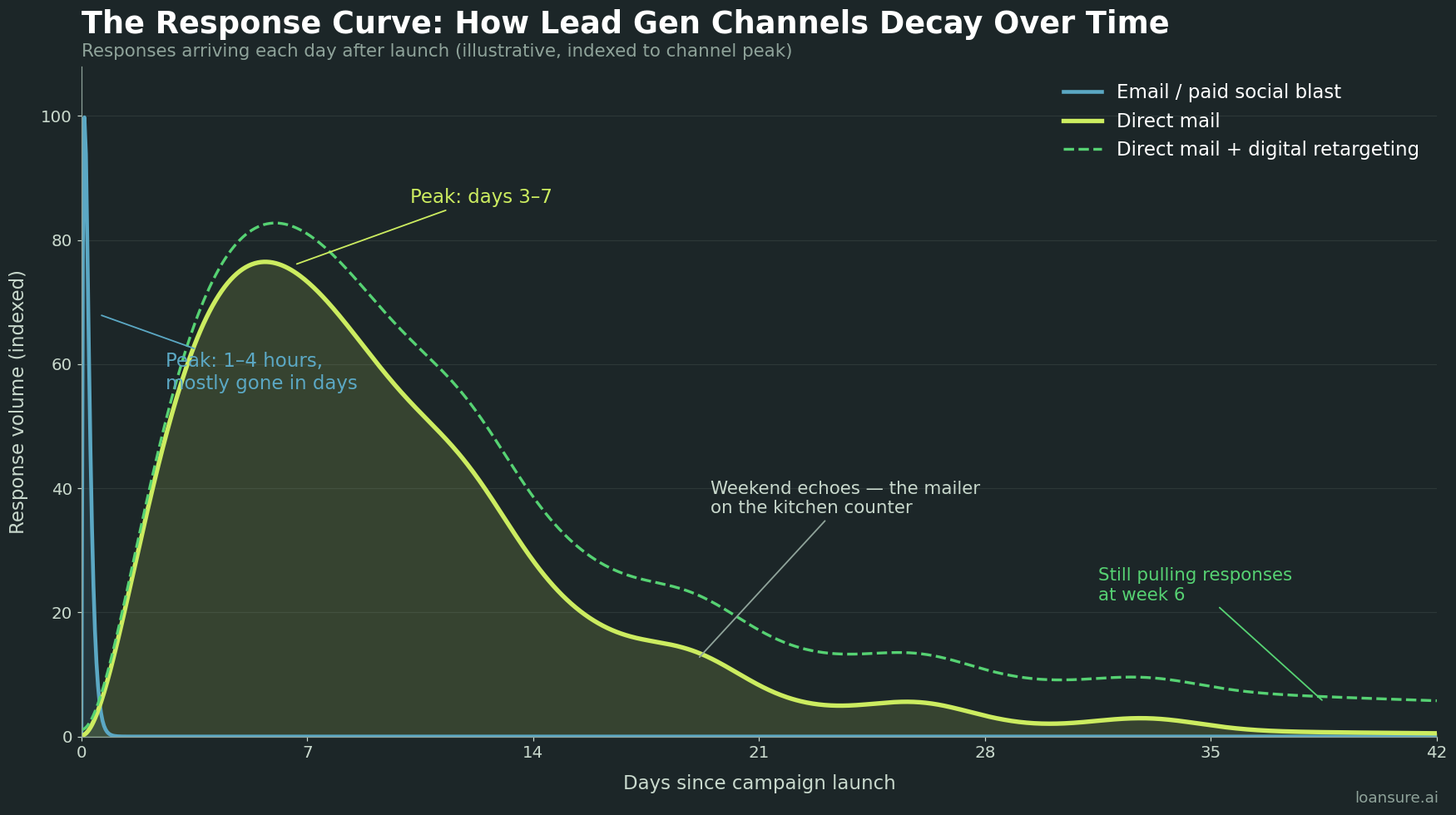
Here's how the two profiles compare on the numbers most industry studies converge on:
| Metric | Direct mail | Digital lead gen (email, social, search) |
| Peak response | 3–7 days after arrival | 1–4 hours post-launch |
| Typical response rate | ~4.4% average; 5–9% for well-targeted house lists | 0.1%–1.0% depending on platform |
| Shelf life | ~17 days average in-home retention | Seconds to hours before it's buried or deleted |
| Primary friction | Logistics — print and delivery time | Fatigue, ad blockers, overflowing inboxes |
Neither shape is "better." They're different tools. The spike is speed; the curve is persistence. The mistake is running both and managing them as if they behaved the same.
Why mortgage direct mail letters keep working after digital ads disappear
The kitchen counter effect. A digital ad disappears with one swipe. Mortgage direct mail letters get set on the counter, stuck to the refrigerator, left on a desk — a standing, tactile reminder that gets seen (and often discussed by more than one decision-maker in the household) multiple times before anyone acts. For a decision as significant as a mortgage, that matters: nobody impulse-buys a cash-out refinance from a story ad.
Delayed decisions are real decisions. Recipients frequently sit with a mail piece until they have time to think — which is why mail programs show secondary surges of calls and site visits on weekends, well after the piece landed. Those weekend echoes are visible in the curve above. A homeowner who calls on Saturday morning, coffee in hand, mailer in front of them, is a fundamentally different conversation than a lead you had to dial within five minutes of a form fill.
The curves compound when you stack them. This is where channel-agnostic thinking pays. Synchronize digital retargeting — banners, email nurture, landing pages — with a mail drop, and the digital layer stops being a firework and starts riding the mail curve, lifting response for weeks instead of hours. The dashed line in the chart is the point: multichannel isn't about being everywhere, it's about matching each channel's decay profile to a job it's actually good at.
What decay rate means for your operation
This is the part most lenders miss. The shape of the response curve dictates operational strategy:
Staffing. A spike channel demands surge capacity — every response arrives at once, and speed-to-lead is everything because the demand evaporates in hours. A curve channel produces steady, forecastable call volume you can actually staff a floor against. If your dialer team is sized for spikes and your demand arrives on a curve (or vice versa), you're paying for the mismatch every day.
Measurement windows. This is why direct mail ROI in mortgage marketing is so often mismeasured. Judge a mail program at day five and you'll kill campaigns that were about to pay for themselves. Judge a digital blast at week four and you'll credit it with momentum it never had. Long-tail channels need long measurement windows — we evaluate performance on rolling multi-week averages precisely because that's the timescale the curve actually plays out on. Measuring a channel on the wrong clock is how good programs get cancelled and bad ones survive.
Pipeline resilience. Spike channels are auction-priced — when rates move and every lender floods in, your cost spikes with the demand. Curve channels, planned as a consistent program, deliver volume on a schedule you control. A portfolio blended across decay profiles is how you get a pipeline that doesn't whipsaw with the market.
The takeaway
Channel decisions usually get made on two numbers: response rate and cost. The response curve is the third number — and it quietly determines whether the first two are even measured correctly.
Effective direct mail for mortgage lending isn't about the piece; it's about planning around the curve the piece produces. The same physics applies whether you're a consumer-direct lender, a bank, or running direct mail for mortgage brokers — and it's the first thing to ask about when evaluating mortgage direct mail companies: do they plan, staff, and measure around the curve, or just drop the mail?
We build acquisition portfolios across mail, digital, and voice not because we're sentimental about any channel, but because their curves do different jobs: some open the conversation, some sustain it, some catch the response that arrives three Saturdays later. The system's job is to orchestrate them — and to measure the whole thing where it counts: at docs out.
Want to see what your response curve looks like across channels — and what it means for how your floor should be staffed? Let's talk strategy.